

Tessellations: The Hidden Geometry Behind Nature's Most Efficient Structures
Tessellations understood using Biomimicry are a result of evolutionary pressures that favor patterns maximizing efficiency, strength, and adaptability in living organisms, ecosystems, and Democracy.

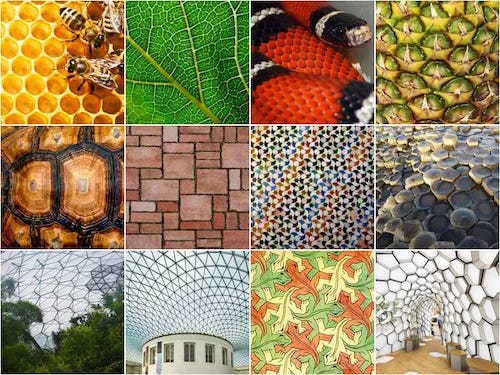
Tessellations in Nature
Tessellations, or tilings, are patterns formed by repeating shapes that fit together perfectly without gaps or overlaps. While often associated with art and mathematics, tessellations are also abundant in the natural world, where they arise from biological, chemical, and physical processes.
Common Examples of Natural Tessellations
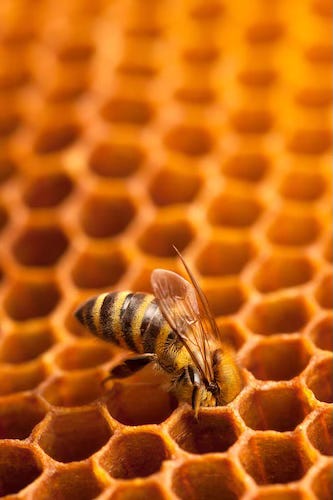
Honeycombs: The most famous natural tessellation, honeybee combs are constructed from hexagonal wax cells. The hexagon is the most efficient shape for filling a plane with equal-sized units and minimal material, which is why bees use it to maximize storage and strength.
Snake Skin: The scales on a snake's skin often form diamond-shaped or hexagonal patterns, creating a seamless, protective surface.
Turtle and Tortoise Shells: The shells of turtles and tortoises exhibit tessellated patterns, often featuring polygonal shapes such as hexagons and pentagons, which provide both strength and flexibility.
How Tessellations Form in Nature
Natural tessellations emerge from processes of growth, division, and packing.
Biological Growth: Cells in living organisms often grow and divide in ways that lead to tessellated tissues, such as the epidermal cells in plant leaves or the scales on reptiles.
Evolutionary Efficiency: Shapes like hexagons and other polygons are favored in nature because they allow for efficient use of space and resources, minimizing gaps and maximizing strength.
Tessellations in Architecture and Engineering
Tessellations play a significant role in both architecture and engineering, serving aesthetic, structural, and functional purposes.
Historical and Decorative Uses: Tessellations have been used decoratively since ancient times, notably in mosaic tilings and ornamental motifs in Islamic architecture, such as the intricate Girih and Zellige tiles of the Alhambra and La Mezquita.
Traditional Chinese architecture also features tessellated patterns in windows and floor tiles, emphasizing rhythm and regularity.
Structural and Functional Applications
Load Distribution and Stability: Tessellated patterns help distribute stress evenly across surfaces, enhancing the structural integrity of buildings and engineering components. For example, dome structures often employ tessellated patterns to distribute forces evenly, thereby increasing their stability and resistance to failure.
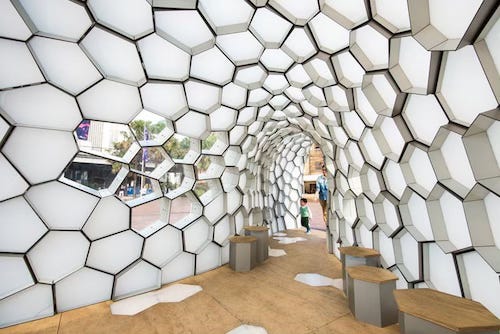
Material Efficiency: By dividing surfaces into repeating units, tessellations allow for modular construction and standardization. This approach can reduce material waste, simplify manufacturing, and facilitate repairs, as the failure of a single module is less likely to compromise the entire structure.
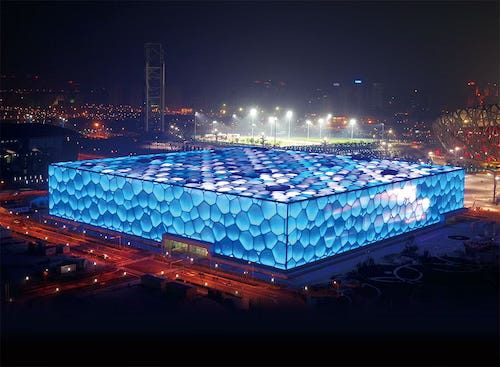
Panelization and Facades: Tessellated modules are commonly used in modern facades and panel systems. The Beijing National Aquatics Center ("Water Cube") employs Voronoi tessellation to create its iconic, bubble-like exterior, combining visual appeal with structural efficiency.
Bridge and Structural Optimization: In engineering, tessellations divide complex design spaces into smaller, manageable parts. This allows engineers to analyze and optimize each section efficiently.
For instance, bridge frames can be designed with various tessellation patterns to optimize load-bearing capacity and minimize deflection under stress.
The Connection Between Democracy and Tessellations
Tessellations are used to explore concepts in social and political theory, as well as Democracy.
Tessellations as a Model for Democracy
In the art world, particularly in the work of George Woodman, tessellations have been described as embodying a "democracy of parts." Woodman's systematic approach to pattern emphasized that each shape in a tessellation has equal status within the overall composition.
There is no single dominant element; instead, every part contributes equally to the whole, suppressing traditional figure-ground relationships and hierarchical structures.
Unlike looser patterns, tessellations make it hard to see separate figures and backgrounds. Instead, they emphasize how each part connects directly to the next rather than how each part fits into the overall design.
In systems where all components are equally significant, traditional ideas of structure or hierarchy become irrelevant. Instead, elements interact freely within a flexible, open-ended framework that allows infinite combinations unbound by fixed relationships or limitations.
This approach reflects a core democratic principle: equality among constituents. Just as each tile in a tessellation is essential to the integrity of the pattern, each individual in a democracy is fundamental to the functioning of the society. There is no "center" or "edge" that is more important; all parts are interdependent and collectively create the complete system.
Tessellations in Political Theory
Beyond art and education, the metaphor of tessellation has been extended to political theory. For example, the concept of "tessellating dissensus" has been used to describe forms of Democracy and resistance, where multiple autonomous entities (like municipalities or communities) fit together to form a larger, non-hierarchical structure. This suggests that Democracy can be envisioned as a tessellated system composed of diverse, self-governing parts that together create a unified, adaptable whole.
Tessellation of Democracy is NOT what Trump and his followers want. They seek an extreme hierarchy in which one branch of government dominates all others. That's not how our Constitution works.
Virtually all Republicans and many Democrats are not willing to push back against Trump's Autocracy, so it's primarily up to us.
Please see the suggestions below to join the resistance and stop this approach, pushing our Democracy away from this destructive path.
Please remember the NO KINGS protest on Flag Day, June 14th.
Thank you so much for reading my posts!
To learn more about Biomimicry
biomimicry.org
To take classes in Biomimicry
For a great example of decorum and civility with strength and conviction, I would watch videos on Schiff Notes from Senator Adam Schiff. To protect our Democracy, I suggest the following:
Please Join Advocacy groups like Indivisible and receive your political information from the unedited Substack posts.
Four out of many Law Firms fight for Democracy every day!
Elias Law Group, Democracy Forward, Public Citizen, and CREW
For a summary of legal and Democracy Resistance updates, see